۱.
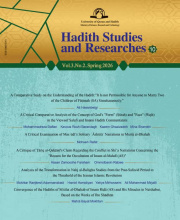
The jurisprudential commandment on ʻĀshūrā day’s fasting has caused controversy and disagreement among Shia scholars considering the existence of two categories of narrations in the hadith books. This research aims to analyze and validating the two types of narrations on fasting on ʻĀshūrā using descriptive-analytical-critical methodology. The findings indicate that according to the criterion presented by the impeccable Imams regarding innovation, the narrations permitting fasting on ʻĀshūrā were based on taqīyyah (dissimulation). Additionally, the Sunni narrations seem to be fabricated regarding the presence of courtiers as narrators and conflicting content. Although the narrations prohibiting fasting on ʻĀshūrā have weak sanad, they are stronger in terms of prohibition. The significant behavior of Kulaynī in relying only on the narrations of prohibition indicates a lack of credibility in the narrations permitting fasting on ʻĀshūrā. The narrations of prohibition are acceptable and confirm the sanctity of fasting on the day of ʻĀshūrā due to their consistency with the tradition transmitted from the Imams.
۲.
One of the important linguistic aspects in the field of literature and culture is the identification of linguistic roots, lexical changes in multiple languages, and the discovery of the historical evolution of meanings. Essentially, research in the field of linguistics is crucial for increasing human knowledge. The goal of research in word etymology is to find answers in recognizing cultural fluctuations in literature and various human cultures. It is clear that languages influence each other throughout history. Every linguistic change in each historical period reflects a particular cultural approach of that time. In other words, linguistic changes are a reflection of changes in the values and beliefs of a culture and may even lead to the transformation of a culture. The present study aims to investigate the word "Qahramānah" using a descriptive and library-based approach, which is especially significant in the realm of women's culture. The author's effort in this investigation is to explain the mutual influence of languages, the etymology of the word "Qahramānah" in Persian, Turkish, and Kurdish, and the transfer of the word from Persian to Arabic, as well as its use in the words of the Prophet Muhammad (PBUH) and Imam Ali (AS). The Results, based on the evidence, indicated that the word "Qahramānah" originates from Middle Persian in Pahlavi, and later found its way into Arabic and religious sources based on the factors mentioned in the article.
۳.
The responses of impeccable Imams to the question of entering the world into an egg, without changing the volume of both sides, are among the problematic narratives in the field of monotheism, the interpretation of which may be considered as knowing the impossible rational matter by using the analogy of entering the image of objects into the eye, which is not consistent with the content of the original question; the issue does not end there and receiving conflicting dual answers from the Imams to the same question and considering this matter as impossible, are among the other challenges in dealing with this category of hadiths. The present study has used a descriptive-analytical method to explain these hadiths and has found that scholars only accept the apparent indication of the narratives, considering this matter as impossible, and interpret or deny the narratives that have addressed the problem through a metaphorical representation of the world entering the eye. On the other hand, one can interpret some narratives that indicate the possibility of this matter by making changes to both sides and remaining silent, and present a new interpretation based on the theories of "Holography" and "Removal of Empty Space of Atoms" in contemporary sciences, in a way that it can be considered as a solution to resolve the contradiction. In fact, the Imams have sometimes given a precise and real answer to the narrators' current state and needs, and sometimes a metaphorical and tacit answer, so that neither the scholars remain ignorant of the truth nor a pretext for denying the power of Almighty God is created for the ignorant and the opponents. Therefore, merely benefiting from a strange appearance of a narrative or initially understanding it in conflict with reason, knowledge, epistemological geometry, etc., is not a sufficient reason for rejection and denial, and a precise understanding of the hadiths requires multidimensional studies that taking into account the knowledge of contemporary humanity can be one of the requirements that can change the world of hadith understanding.
۴.
In the major encyclopedias of narrative exegesis, over twelve thousand exegetical hadiths attributed to Ahl al-Bayt has been collected. The exegesis presented in most of these narrations is understandable to everyone and can be considered as the meanings of the Qur’anic words. However, in many of these narrations, words, phrases, and Quranic verses have been interpreted in such a way that the reader cannot easily establish a coherent relationship between them and Quranic words. At times, it is suggested that this type of narrative interpretation is not meant to express the exegesis (Tafsīr), but rather to convey the interpretation (Taʼwīl), and it is also posited that the interpretation of the Quran is not confined solely to the linguistic relationship with the words of the Quran, but rather is a meaning that only the Prophet and Ahl al-Bayt can comprehend. The present study aimed to categorize exegetical narratives and examine the linguistic relationship that each category has with their apparent words and meanings. The author contends that any meaning presented as an exegesis or interpretation for the Quran must have a linguistic connection with the Quranic text, and the reader must comprehend this connection through linguistic analysis. Consequently, any meaning offered in the hadiths, whether as exegesis or interpretation, which lacks a linguistic connection with the words of the Quran, loses its credibility and cannot be accepted as the intended meaning of the divine words
۵.
Guidance is necessary for leadership and Imamate, and the guides, with divine care and attention, consciously and steadfastly fulfill their role in this position. What is certain is that the necessity of such guidance includes special knowledge and understanding of all aspects of the world and the characteristics of human beings. The title of the column of light is indicative of one of the foundations and methods of the impeccable Imam's knowledge of hidden and unseen matters. Understanding the truth of the column of light and explaining its function and the reasons for using this title by the institution of Imamate are the three main axes of the present study, which has been organized in an analytical method and library approach. The result of the insight into the transferred knowledge in this area is that the column of light is a reality that signifies the relationship of angels with the center of guidance to achieve the issue of the Imam's knowledge to the actions of the servants, and therefore the internal guidance of the believers by the Imam, alongside other forms of guidance. The two issues of the Holy Spirit and challenge (Taḥaddī) also play a complete role in shaping the third side of the triangle, namely the column of light, and in fact, on the one hand, it provides the Imam with the benefit of a pure and sacred spirit and creates the ground for the angels' communication with them, and on the other hand, it provides the spiritual vessel of the Imam as a channel for the spiritual evolution of the believers.
۶.
In narrative sources and Sirah books, numerous narrations about the physical characteristics of the impeccable Imams have been reported. In some of them, there are narrations indicating denial of their physicality. Among these narrations, there are reports in which the existence of a shadow for the Imams has been denied. In other words, when the Prophet and Imams were in front of light, they had no shadow. The narrators of these hadiths have considered this characteristic as a part of the miracles and virtues of the Imams, attributing it to their "Being of Light," as mentioned in other narrations. The narrations transmitted in Sunni sources are without Sanad. In the narration chain of some Shia narrations, there are unknown narrators and sometimes even exaggerators (Ghulāt). According to the Fiqh al-Hadith science, these hadiths face various challenges. Asserting this belief contradicts the Quran, which explicitly describes the Prophet as a human being like others and only distinguishes him in receiving revelation. This fundamental weakness is also evident from a rational perspective, as a permanent feature for a physical being with physical needs such as food, sleep, etc., which are mentioned in the impeccable Imams' definite Sirah, is not acceptable. The Imams' being of light, emphasized in the Quran and hadiths, refers to their giving illumination in darkness and guidance towards perfection, just as it applies to God. Therefore, the luminosity of the impeccable Imams does not imply their non-physicality. Finally, disregarding the weakness of the narration chain and the content, it can also be suggested that the lack of shadow for the impeccable Imams is a metaphor for their exalted status and does not refer to their physical body. The present study, using a descriptive-analytical method and with a critical approach, examines the narrations indicating the absence of a shadow for the impeccable Imams in the sources of both sects, utilizing library sources.